If you couldn’t tell, I enjoy a good book. I love sitting in my corner of the couch, my husband calls “the gemütlich headquarters,” and reading for 30-60 minutes in the morning. I also enjoy discovering new books. Some of my favorite social media posts and reels are book recommendations. I love finding summaries and, hopefully, adding those books to my reading list on Storygraph. I collect all these book ideas, but I’m not the fastest reader, so I will never finish the list. I also don’t listen to audiobooks because I won’t pay attention to them, and honestly, I love the smell of a book (especially a hardcover). So I won’t have 40+ books read by the end of the year. My personal goal is to read 12 books a year.
One thing I find interesting is that with social media, reading has become a job. Everyone needs to read every book that comes out. There’s this weird pressure to read at least one book a week, but it’s only a book influencer’s job to read that much and recommend them. That’s not what I’m trying to be. Along with their book suggestions, I constantly see posts with tips and tricks for reading more. The most I’ve read in a month is three books, and that’s a lot for me (it was also January, so I wasn’t busy). Still, I do feel pressure to read more.
I’m actually not writing this blog post to discuss the pressure from social media to read more, though. I want to talk about a personal struggle I faced a few months ago, a struggle that caused me a weird amount of discomfort—quitting a book. Last fall, I was recommended a book on BookTok. Overall, the reviews on Storygraph were mixed, but I decided to give it a try. I began reading this book, which was less than 300 pages, so in my mind, if it was good, I could finish it within 10 days, and boy, was I wrong. It took me 10 days just to read 96 pages. It felt like nothing was happening, and by page 96, I had to put it down. Reading that story didn’t feel enjoyable, and I completely lost interest; I no longer cared about the characters. It was a hard decision because I had already put in time and effort, but I knew I had to put it down.
After I decided to give up on the book, I felt guilty. I questioned if I could still call myself a reader. I thought I wasn’t a “real reader” because I didn’t want to challenge myself.
Once I picked up a more engaging book, I realized my reason for reading isn’t necessarily to challenge myself, especially when it comes to content I just don’t like. I read because I want to be entertained. I read to learn. I read to escape and explore new worlds. I read because I care about the themes. I read because the author carefully created fully developed characters I care about. And that story didn’t have any of those things.
I’m not trying to read every fcuking book on the planet, and I won’t be reading to push through over 90 pages without feeling rewarded. Some people may like that, but I don’t, and it’s okay.
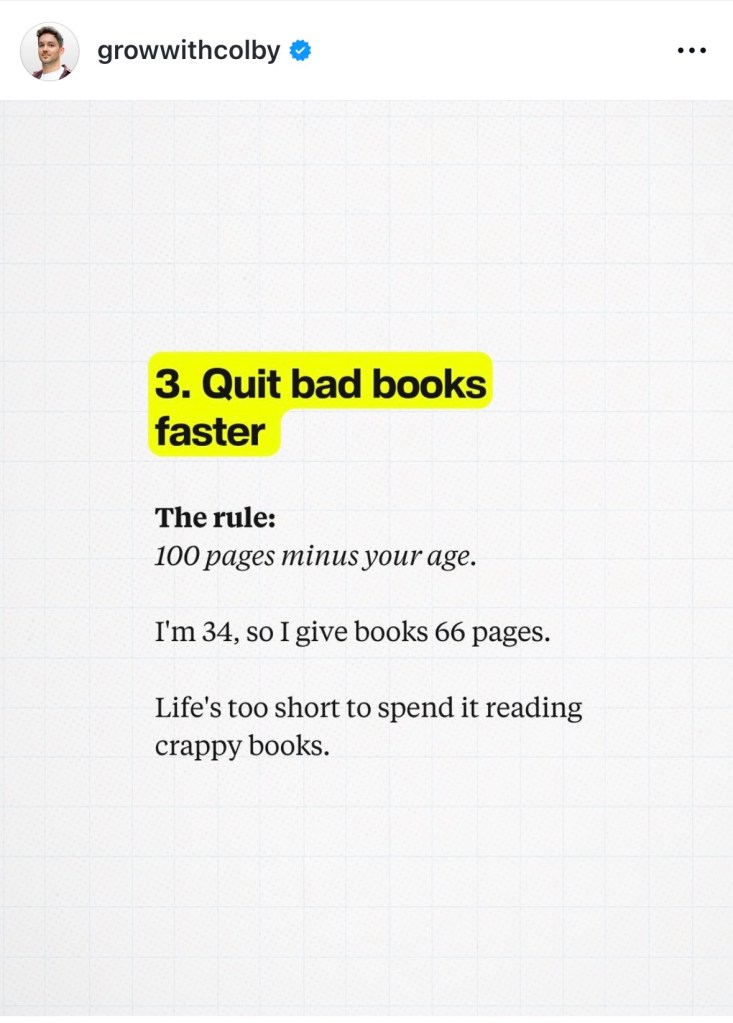
“Life’s too short to spend it reading crappy books.”
I came across this recommended post on Instagram from @growwithcolby about how to read one book a week. I’m obviously not trying to read at that rate, but in his post, he suggests to “Quit bad books faster”. His rule was to read 100 pages minus your age, then decide if the rest of the book is worth your time. Being 36 means I should read until page 64. If I’m not into the book by then, I should quit it. “Life is too short to spend it reading crappy books.” I think I will try that rule this year, not to read more books, but to get it into my mind and body that it’s okay not to like where a story is going.
Don’t waste your time on books you don’t enjoy to please others.
Another takeaway from @growwithcolby was simple: “Read books you actually want to read.”
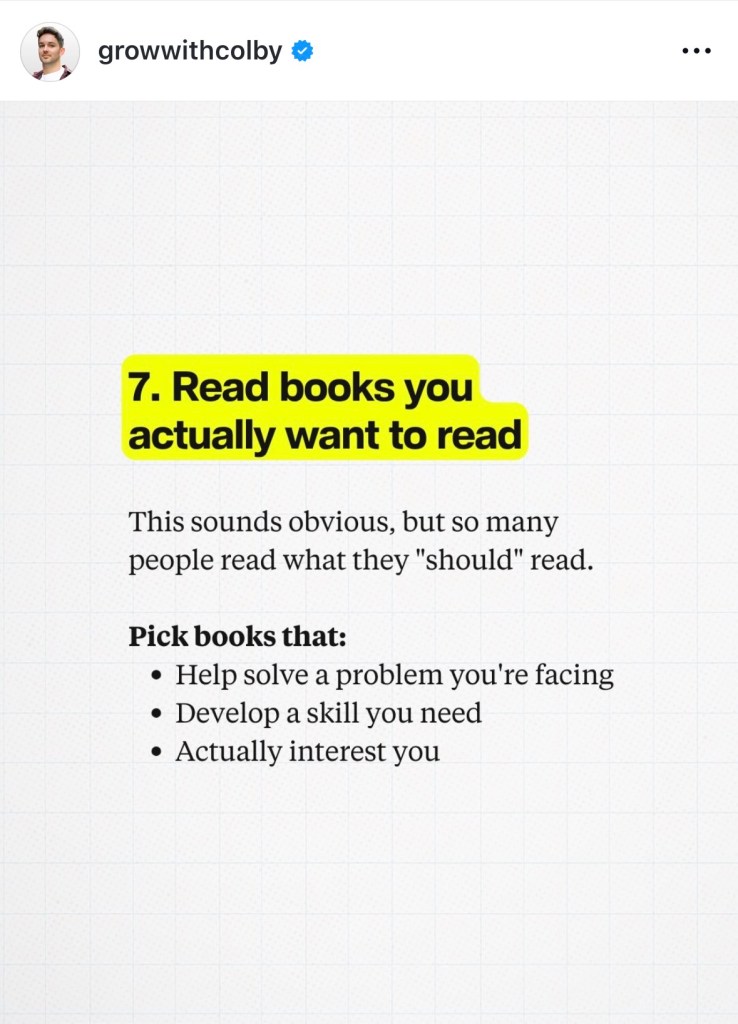
Our book choices are quite personal, and over the past few years, I’ve figured out what kinds of books speak to me. I love a good mystery and adventure with lots of twists. I’ve also realized I’m not into autobiographies or memoirs, so I usually don’t read them. Years ago, I forced my way through Michelle Obama’s Becoming because I admire her, but I’ve realized I’m not as interested in that genre.
Don’t get me wrong, I don’t think it hurts to explore different genres and themes. Sometimes I just want to switch it up. Sometimes I want some character-driven, emotional, and reflective stories like Beloved. I’m becoming a fan of historical fiction thanks to Homegoing, and I’ve been wanting to read more “literary classics” (I suppose that’s what they’re called). For example, I randomly picked up Wuthering Heights without really checking what it was about, and ultimately I enjoyed it. I’ve also been revisiting books I had to read in high school, like To Kill a Mockingbird, more so to reflect on why I had to read them in the first place. My point is that it takes trial and error to discover which books interest you. This is also why libraries are so important: for discovery. Borrow all the books you want for trial and error. No money spent, less guilt.
What should never happen is reading a book just because you’ve been led to believe you should. Also, connecting us back to social media pressure, if you want to read one book a week, do it because you want to, not because anyone says you should. At my grown age, when I’m not getting a grade, no one can tell me I have to do anything. Why add the stress? If you like reading autobiographies, do it. If you like reading about politics, do it. If reading romantic fantasy is your thing, do it. Just don’t make anyone feel like their book choices are less than, and don’t waste your time on books you don’t enjoy to please others. Reading is reading; we don’t need to be interested in any particular genre or read at a pace that may impress people we don’t even know.
I love reading, probably more than I enjoy watching movies right now, so yeah, it’s kind of hard for me to admit when I just don’t like a book. I know I need to work on my own DNF guilt, and maybe you think it’s silly to feel guilty about it. As readers, though, we invest so much time and effort into the experience of reading; it’s not easy to just let go of a book. But not all books are created equal; some books are exciting, some feel challenging, some make you think, some make you feel, but also, some books are just bad. Sure, a story being bad is a matter of personal taste, and someone else might have loved it, but we shouldn’t waste time on things that aren’t serving us or helping us grow as individuals.
Just to confirm: If you read a book, you’re a reader. If you listen to an audiobook, you’re a reader. If you start a book and decide to quit it, you’re a reader who just happens to know when a story is no longer worth your time.
.always.
Dani
 All of Her Things
Leave a comment